
Have you ever clicked the shutter and just knew that you’d captured a masterpiece? Ever had a surprise when you got a look at the image?
Today I’ll explore why the delay that film photography introduces between exposing an image and viewing it can be joy-inducing. I’ll also admit right here that the same delay can be a buzz-kill. You’ll see what I mean.
The Anticipation Matrix
If you’ve worked in or studied leadership, you may have been exposed to the love that management consultants have for four-quadrant diagrams to illustrate and discuss simple concepts. Well, I’ve designed a diagram of my own here, which I’m calling the Anticipation Matrix.
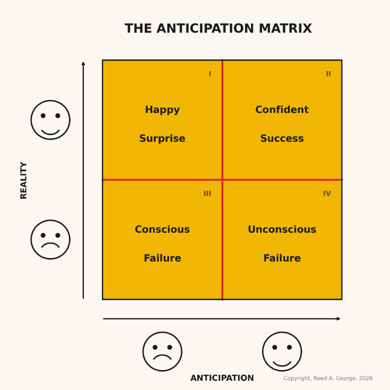
Some explanation is in order. The horizontal axis (Anticipation) represents how the photographer expects the final image to look, based on the experience of taking the picture. The vertical axis (Reality) is the actual quality of the final image. The upper half of the square is when the image comes out great; the lower half of the square is when the final image is crap. Let’s begin in the happy space: in the top left (quadrant I), our photographer thinks they messed up, but the actual developed picture turns out to be better than they anticipated; a “Happy Surprise.” In the upper right (quadrant II), our capable photographer knows they got it right, and they are correct; that’s “Confident Success.” In the lower left (quadrant III), the photographer anticipates a substandard image after exposing the film (knows they messed up), and reality proves that out; let’s call that “Conscious Failure.” And finally, in the lower right (quadrant IV), our unfortunate photographer is convinced they’ve just exposed a once-in-a-lifetime image only to be let down when they see the actual developed picture; that’s “Unconscious Failure.”
Some Real-World Examples
I’ll share one example that landed in each quadrant from a single roll of film that I shot last year. Using one of my favorite cameras (Fujifilm GF670 medium format folder) in one of my favorite locations (Point Reyes, California), I can say that my overall expectations were high. Let’s see some results.
I’ve decided to present the four quadrants out of numerical order.
Quadrant II, the Confident Success
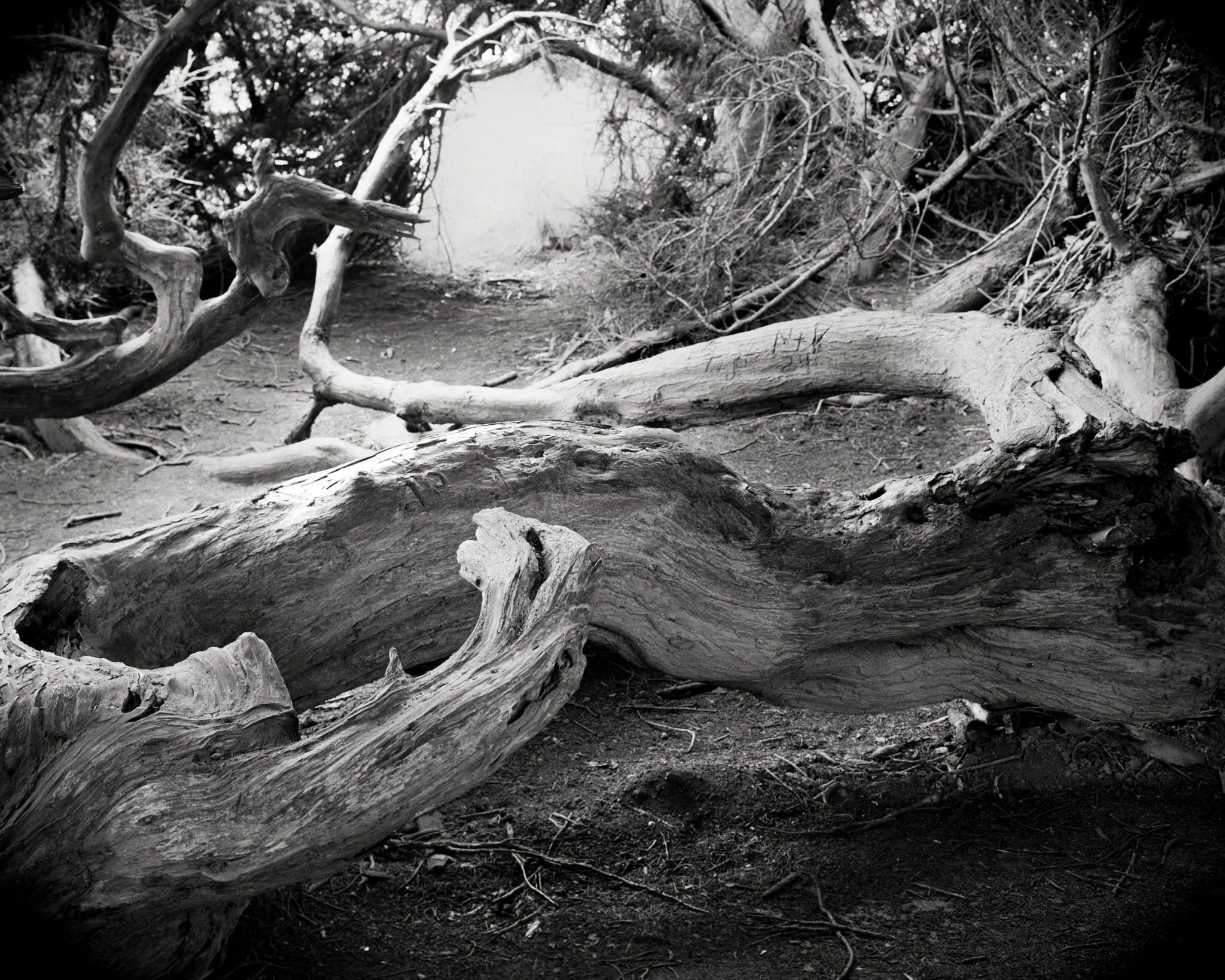
I saw this scene inside a dense stand of coastal cypress and immediately felt something. The contrast of the dark shadows inside and infinite brightness outside gave it a flow, a sense of mystery. That blown-out whiteness isn’t a bug here; it’s a feature. You don’t need data everywhere in an image. The tortuous writhing of the downed trees gave just enough complexity. It took me a while to position my tripod for the right composition, minimizing the smaller underbrush which could have been distracting. When I finally released the shutter, I was confident that I’d made something interesting. And if I may indulge myself, this image meets my expectations.
Quadrant III, the Conscious Failure
Just to ground myself a little after a self-described success, here’s a conscious failure.
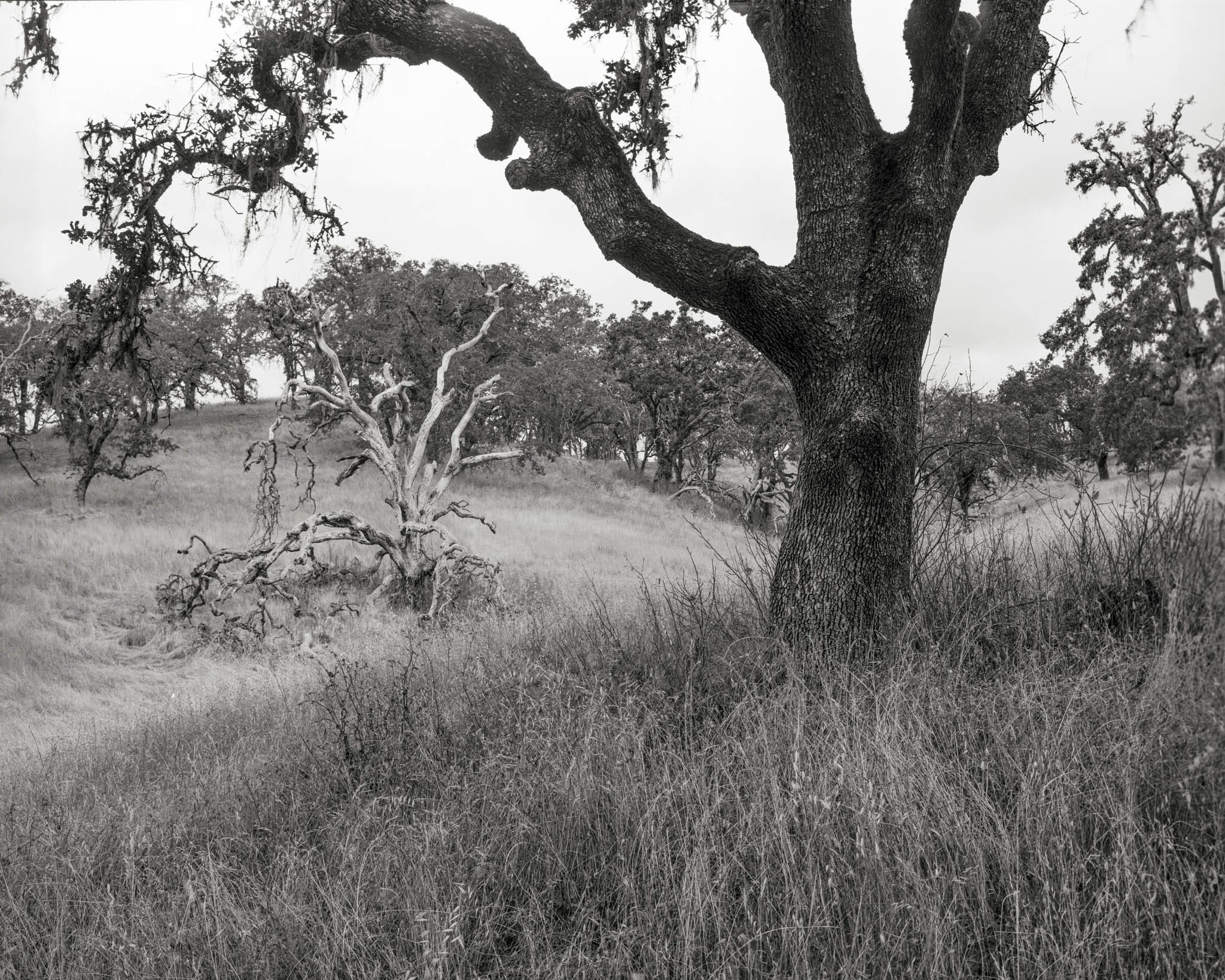
Why did I even take this picture? Yes, I thought the dry hills of Marin County also deserved some attention. And yes, the terrain has a certain type of beauty. I sure didn’t show it here. The half-hearted attempt at using a natural frame just fell flat. Bah, I should have saved that expensive frame of Ilford PanF Plus 120 film for something else. I knew it was not going to be an important image, and I was correct.
Quadrant IV, the Unconscious Failure
What’s worse than an image you knew wasn’t special? Finding out that one you thought was special, well, isn’t.
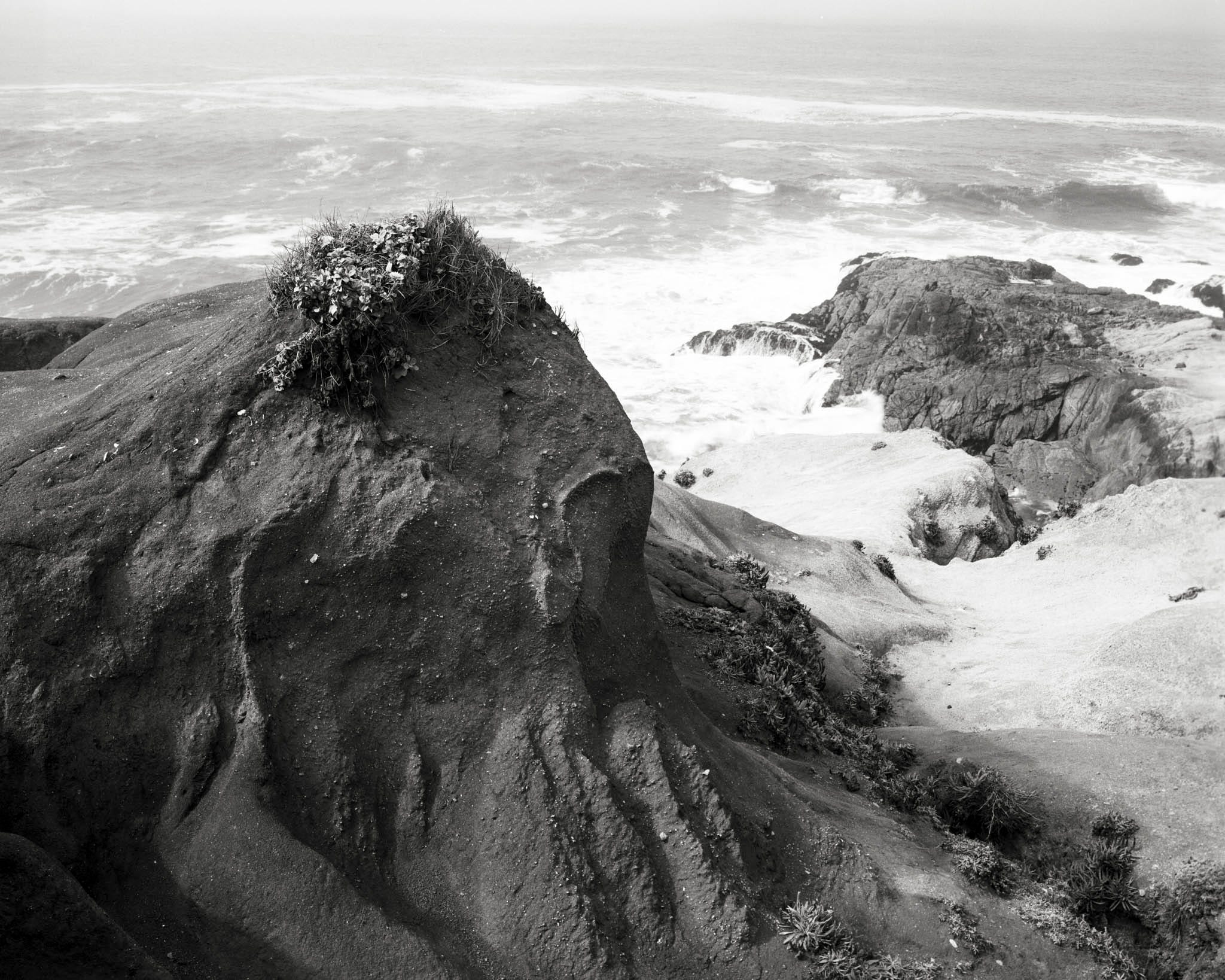
I honestly thought this was something. I mean the Northern California coast, where Edward Weston helped to define excellent landscape photography, an awesome modern medium format camera, and a purist’s choice of black and white film, right? It really felt right. It really wasn’t.
Quadrant I, the Happy Surprise
Now it’s time to put away the knife and get back to the top half of the matrix.
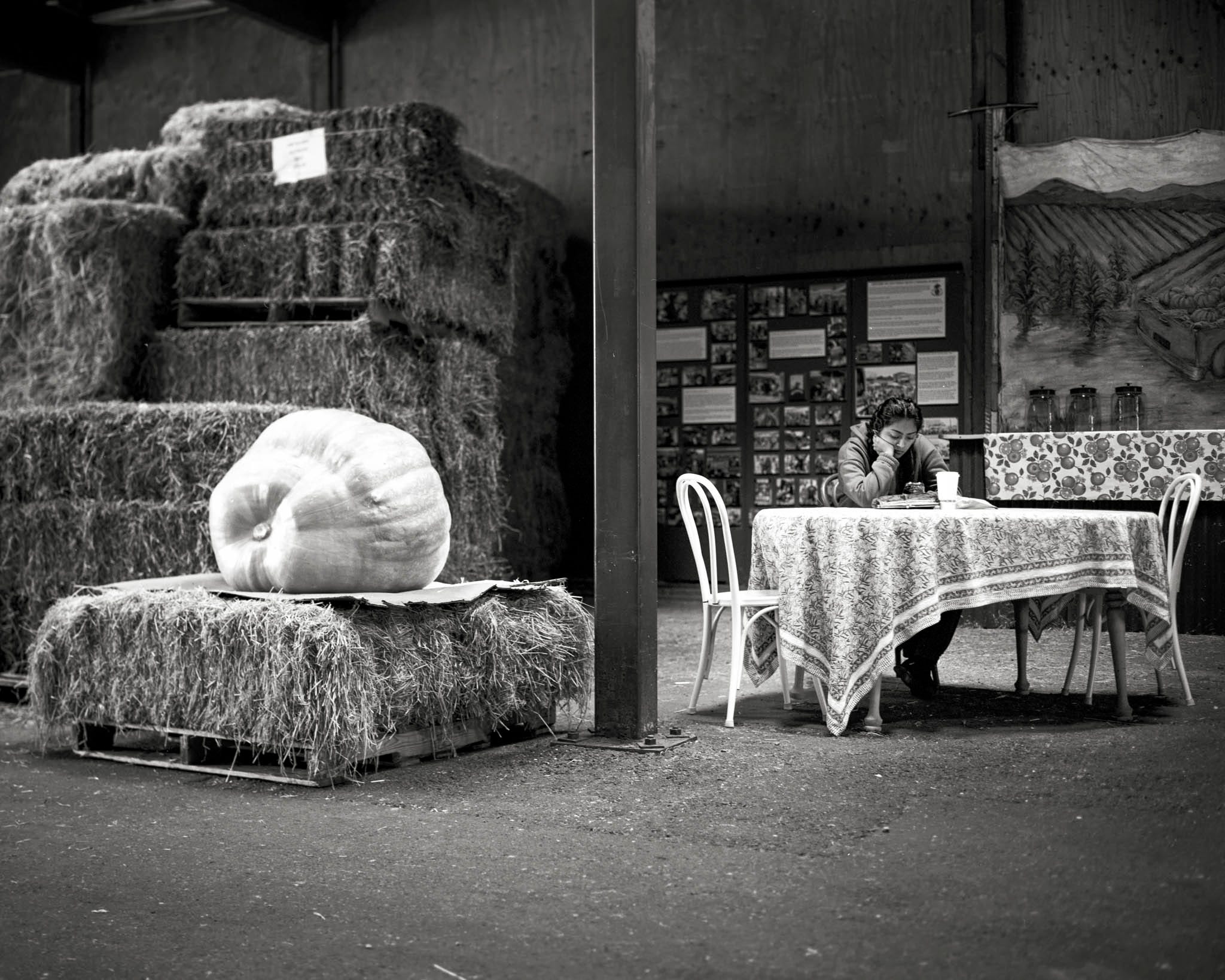
This was a tough shot to make. As I mentioned, I was shooting PanF (iso 50) in a camera with a maximum aperture of f/3.5. This scene was inside a building with some natural light coming in from both ends, but not much of it. I saw the giant pumpkin and thought that was really cool. Without something to show its scale, it would have been boring. I knelt, braced my camera on my knee, and took my best shot. I didn’t know if either the young lady or I had moved during the relatively long exposure (I’m guessing it was 1/15 of a second?). I didn’t know if I’d exposed it right overall, or if my depth of field was sufficient to keep the pumpkin and the person both in focus.
Now, reality. I love this image. And generally, that’s what I’m going for: personal creative fulfillment. I feel that I got the exposure just right – details in the highlights of the pumpkin, while not making the whole scene feel brighter than it was. I love the vertical beam that sort of cuts the image into two halves, but leaves them somehow connected. Redemption.
And what does all of this have to do with film?
You may have experienced all of these combinations of anticipation and reality with digital photography. I admit that I have on a small scale. “Chimping” on the back or through the electronic viewfinder of a digital camera can only show you so much. I will say that I have experienced a disconnect between anticipation and reality in digital photography where once I get the image onto a large screen or printed on paper, it doesn’t match up with my impression while viewing it in-camera. Usually, that’s a negative disconnect. I rarely think an image looks bad in-camera and then get a happy surprise back in the digital darkroom.
Shooting film, it’s actually fairly common that I have a Happy Surprise. And there’s the time element of having to wait for processing. I enjoy not having much of a clue whether I nailed a shot or not. I love the feeling of looking at a wet negative as I unspool it in the darkroom. That’s excitement! Way different than looking at an LCD a few seconds after clicking the shutter. And that excitement is equally high when I send my color film out for developing. That email from The Darkroom (my favorite lab, www.thedarkroom.com) makes me click faster than just about anything.
Writing this brought up a question for myself: so why do I rush to develop film, then? I have always developed my film soon after exposing, and not for technical reasons. The only exception is when I’m uninspired with what I shot (low anticipation). Sometimes those rolls stay around a while. Usually, I’m thinking of when I can get into the darkroom before I’ve even finished exposing a roll of film. I think the reason is that I’m sensitive to anticipation. It motivates me. Delayed reward works for me, but that doesn’t mean I love the delay itself. It’s rewarding when the process is completed.
Wrapping it all up
So, what do you think? Does any of this make sense to you? Do you have similar experiences? Do you agree that shooting film is different from digital in this aspect?
How can we avoid spending too much time in the lower half of the matrix? Certainly not by avoiding risks; that would be boring. There’d be no Happy Surprises. So, I think that we have to take some Failures, both Conscious and Unconscious, to move up to the top of the matrix. And yes, with increased skill, we can probably move more toward quadrant II, where we’re confident of the great shots we’re making. For me, quadrant I is just as great.
Interesting approach to thinking about anticipation (now I’ve got the Carly Simon song stuck in my head). I recently shot a roll of film and had a couple of quadrant 4 shots where I knew I’d used the wrong aperture/shutter speed and one I accidentally fired off before composing. And I had a couple in quadrant 2 that I was pretty sure would be keepers. It’s those other ones, where you just don’t know, that make film interesting. One of the things I really enjoy is the surprise of seeing things in the negatives that I didn’t see when taking the shot. This happens a lot in black and white. Seeing how the tones play together, the shadows and lights, and how they complement the graphical elements (or not). That’s what’s fun for me when the negatives appear.