
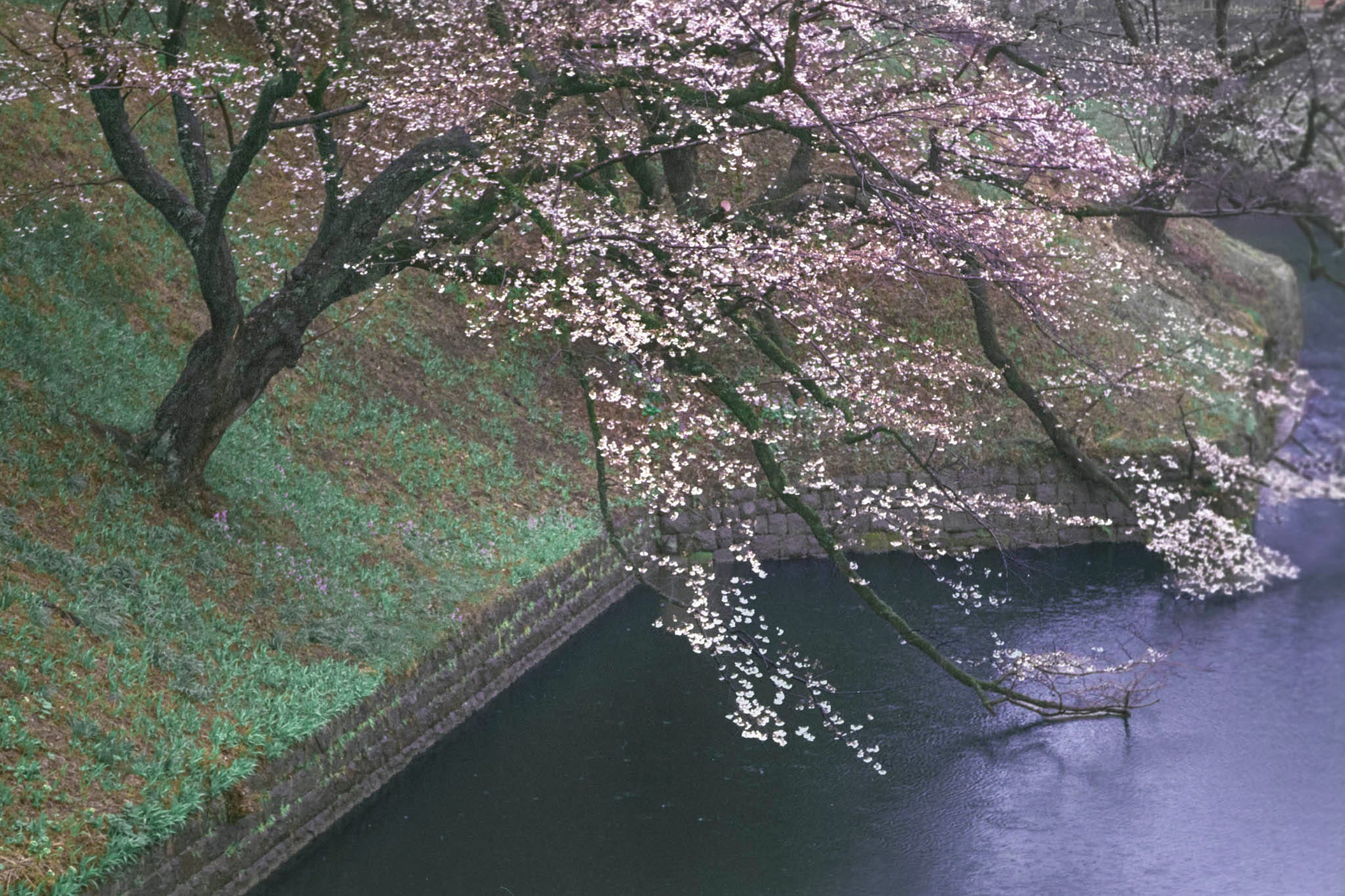
Chidorigafuchi, Tokyo, Japan, 2026
Leica M6, Cosina-Voigtlander 90mm f/3.5 APO Lanthar (LTM)
Fuji 400 Color Print Film
Live at Budokan! That’s what I had in mind as I trudged through the driving rain from Tokyo’s Kudanshita station before sunrise on March 26, 2026. Funny how our minds work in situations like that.
I’d had not a single moment of hesitation in dressing in the dark, grabbing my compact backpack loaded with my Leica M6, 28mm Elmarit pre-aspheric, 50mm Summicron ASPH, and Cosina-Voigtlander 90mm f/3.5 APO Lanthar lenses, and heading out into the spring rains. It was a brief period of solitude, and yes, the potential to create something meaningful, while my family slept better than I had been able.
I’d been to the Kudanshita area a day or two before and while I knew that the sakura had not yet hit peak bloom, the cherry trees in the area were primed to live up to their fame in making this one of Tokyo’s most well-known sakura viewing points for a short week or two each year. So popular that on weekends during that period the sidewalks are reduced to one-way traffic to keep the thousands of visitors moving through. I was virtually alone on my pre-dawn walk in the rain on this morning.
There’s something special about Tokyo without crowds. Maybe it’s the same with any large city? I have experienced it so many times in Tokyo because the particular jet-lag you get from flying there from the United States leads to very early awakenings. When I think of Tokyo it usually brings to mind unimaginable crowds, the crush of rush hour train rides, the vast population that ensures that whatever you may be interested in, no matter how specific, you can find it in Tokyo. But it’s not really a city that never sleeps, in my opinion. Yes, my morning walks do sometimes lead me to encounter small groups of young people who’ve been out drinking all night, bowing their goodbyes to each other before going on to whatever their days may bring. But for the most part, mornings are peaceful, unpopulated. For me the crows (“karasu” in Japanese) that are so common in Tokyo are also hallmarks of early morning. Black as the night itself, they rule the early morning streets.
Getting off the subway at Kudanshita, I walked right by Budokan, the same Budokan where Bob Dylan performed live for his 1978 album “Bob Dylan at Budokan.” In fact, I had a short text exchange with a colleague back in the United States as I went by that morning. I told her that I was “live from Budokan” at that very moment. Work concerns covered for the moment, my colleague went on with her evening back in the United States as I looked ahead to what the morning and day would bring.
I walked for a couple of hours, making my way through Kita No Maru Park, with a few isolated yet gorgeous sakura displays, looping back by Chidorigafuchi Boat Piers, where friends and lovers who plan far enough ahead can rent boats to paddle beneath the legendary sakura in this very special place. It was here that I made the image above.
I found it difficult to find the scene I wanted to record that morning. While I had brought five rolls of Kodak Ektar 100 film to Japan with me in hopes of capturing vibrant spring colors, on this morning, the roll of Fuji 400 color print film loaded in my M6 was far better suited to the cool rainy weather. The two stops of extra sensitivity also helped in the low morning light. In order to narrow the field of view to include only what was strictly necessary, I chose to switch out my 28mm Elmarit lens in favor of the longer focal length 90mm f/3.5 APO Lanthar. An older lens that hit the market in 2001 in Leica Thread Mount (LTM), I’m always impressed with what it produces. For some reason, on that morning, including less in the frame was exactly what I needed.
You may have heard that you should photograph how a scene “feels.” In fact, I’d recently completed a useful virtual course produced by David DuChemin (https://davidduchemin.com) on that very topic. So much easier to say than to do, I am pleased that I accomplished it once, and just once, that morning. I would also return during this trip, in nicer weather and later in the day, to capture to the extent of my capability the feeling of those paddling with loved ones in this same location. A very different feeling from different times at the same place, but just as genuine and meaningful.
In this image, the angular stone wall of the moat surrounding the Imperial Palace of Japan leads my eye on a slightly complex path through the scene. The dark blue-tinted water of the moat brings back the feeling of my wet rain jacket clinging to my body, the effort required to hold my umbrella over my camera and lens as I made the shot. The mixed green and brown of ground cover belie the fact that it was still early spring. And of course, the sakura bursting from the dark, contrasting limbs of the cherry tree made it all a quiet little celebration. All very quiet, very soft tones, yet strong in the combination of primary (RGB) colors.
I can still feel how tired my legs were, as they always are when I go to Tokyo and walk, walk, walk in search of an image that I can feel. My body and mind ached for the excellent coffee that awaited my return to the subway station, my socks squishy wet inside my shoes. I also still feel the time pressure of enjoying this special moment while knowing that I needed to head back to Ginza to begin a day with my family in the land where my wife was born and raised, where my daughter and I have found our own separate yet intimate ways to feel at home. Maybe more so than at our physical home. As I rode the train back toward Ginza, I had no way of knowing which, if any, of the images I’d made that morning would communicate how I felt. I was satisfied that I’d had the experience and that it will always be part of me. It’s ever so much more rewarding to be able to relive it through this image, and perhaps even transmit a little of the feeling to others.
Someone once said that a picture is worth a thousand words. In today’s world, a picture is rarely worth a second of visual attention. It’s not every day that I capture an image that even I think is worth a thousand words. I’ve decided that when I do, I will write at least a thousand words about that picture.
This image made it to the top of my choice queue as soon as I saw it. There are others, but this is the one that’s most obviously worth a thousand words to me.