
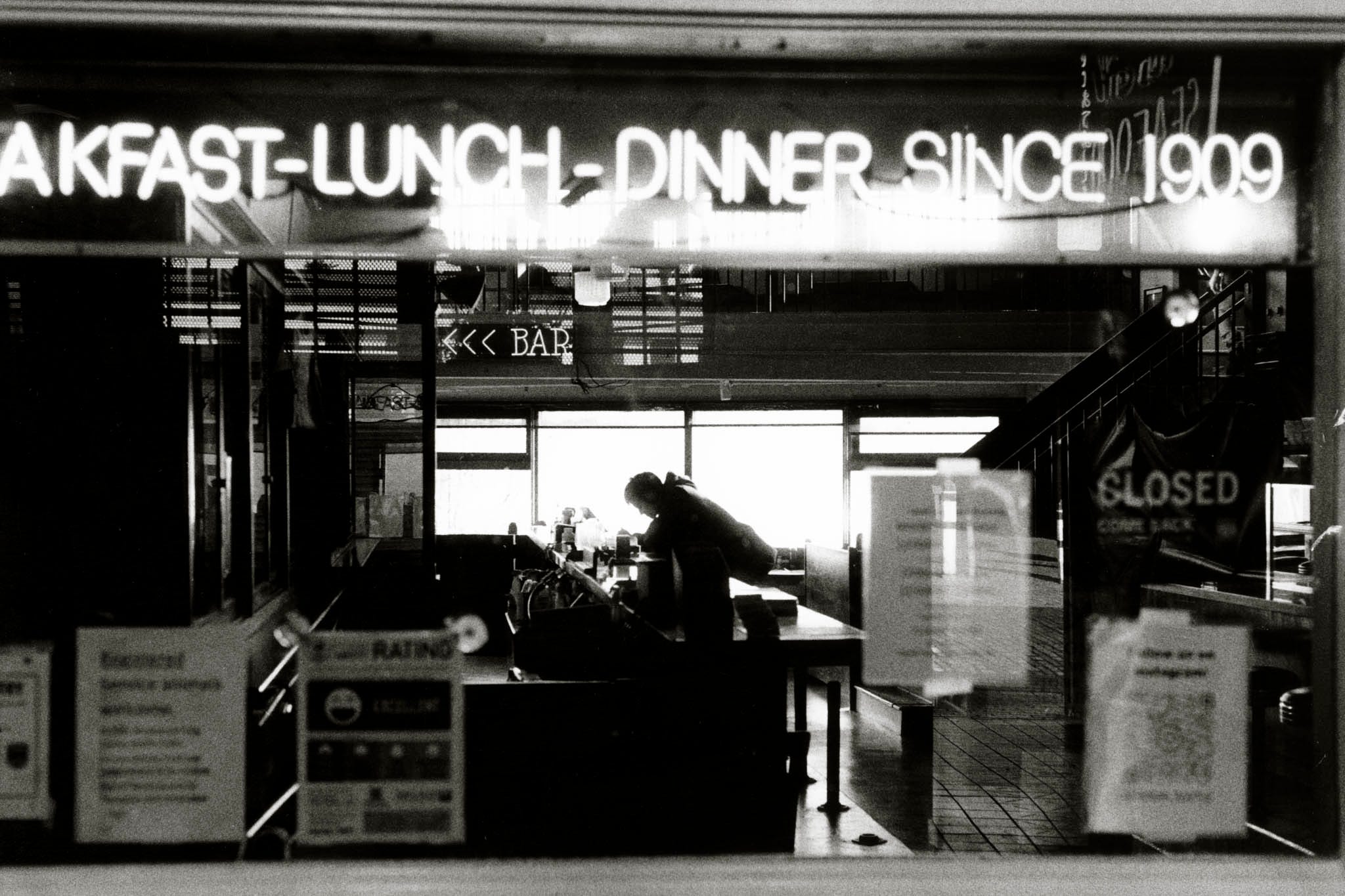
Seattle, Washington, 2026
Leica IIIG, Summicron 50mm f/2 Rigid lens (1999 LTM edition), Kentmere 400 film
Printed on Ilford MG RC Glossy Paper (10” on long side)
The Athenian, a Seattle, Washington landmark, has been open for business since 1909. The stories set here must be countless.
Some are known. It held Seattle’s first beer license after the end of Prohibition. A scene from Sleepless in Seattle was filmed here, though it’s never been a movie I cared much about. Most of the stories, however, are private, or at least shorter-lived. How many proposals have happened here? How many celebrations, arguments, affairs, reconciliations, and goodbyes?
What story is taking place in this image, which I made after closing time on an April evening in 2026?
To me, the story looks like it’s in a final chapter of some sort.
The scene above reminded me of the artist Edward Hopper, who sketched real scenes and details “from the fact,” building them into complex composites of people somehow isolated, separated from the rest of the world in distinctly American settings.
In particular, consider the Hopper painting entitled “Automat” from 1927 (https://whitney.org/guides/79?stop=14075&open=true). A couple of elements of this painting made me feel Hopper’s influence on my visual perception when I stepped up to the window at the Athenian: a single person, alone in a public place designed for larger groups, and the fact that the Automat was a place where food was dispensed from vending machines. I wonder if that early form of mechanization carried some of the same unease that online ordering and ghost kitchens carry now: food without much human encounter.
Looking at the print I made of this photograph in my darkroom, I found myself inventing a story.
I imagined that this was the fourth-generation owner of the Athenian, looking over the day’s numbers after closing time. The restaurant is quiet now. The customers are gone. The spring evening light is fading over Elliott Bay.
Maybe business is becoming more difficult than it once was. Maybe expenses are climbing faster than revenues. Maybe the next generation is willing to take over, if the restaurant can survive long enough for them to do so.
People once came here to anchor their stories on the edge of the continent, looking out toward Bainbridge Island and the Pacific beyond. Today, many experiences arrive through a phone screen. Restaurants increasingly compete not only with each other but with convenience itself.
Perhaps he is wondering what another hundred years might look like.
The longer I looked at the photograph, the more real the story became.
Of course, all of this is made up.
For all I know, the Athenian is thriving, new locations are in development, and the person at the counter was simply checking an iPhone before heading home for the evening.
That’s one of the things I love about photography.
A photograph records evidence, but rarely explanation. It tells us what was there. It tells us almost nothing about what was happening inside the minds of the people it contains. Faced with that uncertainty, we begin filling in the blanks ourselves.
In that sense, photographs and stories have always been close relatives.
A personal example: a few years before my grandmother passed away, she showed me a photograph of her family when she was just a young girl (ca. 1920s?). Standing outside their home in the rural hills of Kentucky, a rough road running just in front of them, there didn’t seem to be much of an occasion for a photograph. But I know that they did not have the means to make images like that without a reason. Turns out, it was a sort of victory photograph. You see, they had won the right to have that road run through their property; it had been a competition with the other subsistence farmers living on the other side of the ridge. My family, the Allens, won access to the new road because the families on the other side of the ridge already had access to a river which could be used for transportation.
Back to the photograph in question, I made it after arriving in the Pike Place Market area later than I had intended. The flower vendors, souvenir shops, and seafood stalls had already closed for the day. The crowds that normally characterize the market had largely disappeared.
The transformation surprised me.
During the day, Pike Place is energetic, loud, and crowded. After hours, it becomes something else entirely. The place feels larger. The shadows deepen. Empty walkways and closed stalls create a sense that the city is briefly catching its breath before starting over the next morning.
And yet, there were still quiet little stories to be found. Walking along the concrete corridors that alternate between open outdoor and interior spaces felt a little like walking along a film strip. Lots of dark frames empty of information, punctuated by occasional frames of light, contrast, and depth. Frames open to interpretation. A little sparse perhaps, but still a great place to be exploring. I just had to look a little longer, a little more closely. Pike Place isn’t large, so I did feel the need to explore every little scene, leaving none behind before I ran out of frames and out of evening light. Carrying a simple camera kit, my Leica IIIG fitted with a 50mm f/2 Summicron lens and loaded with Kentmere 400 black-and-white film, I made a handful of careful exposures.
This scene stopped me.
The person at the counter was just large enough to become an important element in the frame. With a wider lens, I think the figure would have become insignificant. The 50mm lens forced me to make decisions about what to include and what to leave out.
I made a conscious decision to truncate portions of the neon signage. I also chose to focus on the silhouetted figure, allowing the signs on the glass to fall slightly out of focus. I’m pleased that they remain legible while still encouraging the eye toward the person inside.
The Leica IIIG is the last of the Barnack-style Leicas, small and beautifully limited in a way I find appealing. While I love the compact size of these cameras, later Leica M cameras are unquestionably easier to use. Focusing a IIIG in low light can be challenging, especially compared to modern cameras.
But this film photography thing isn’t really about ease.
For me, it is partly about overcoming challenges, controlling variables, and accepting the possibility of failure in exchange for a more deliberate process. The camera asks more from me, and in return it gives me a different relationship with the act of making photographs. And when I’m successful, I feel a small victory of my own.
I shoot film and use vintage cameras for many reasons. In this case, in addition to the challenges the technology presents, I felt a connection to one hundred years of history, both photographic and location related. Looking back at the image now, I think that’s what connects the photograph, the restaurant, and the camera for me.
Places like the Athenian have survived for more than a century because people chose participation over convenience. They showed up. They sat at the counter. They celebrated birthdays, conducted business, fell in love, ended relationships, and created stories that became attached to a place.
Film photography asks something similar of me.
It asks me to leave the house, look more carefully, and participate in the world rather than simply consume it.
Some days, a quick online order and a wait for a knock at the door is exactly what’s needed.
Other days, maybe we should get out and make some stories.